Not built for royalty — built for the people
In today's world, the restoration of palaces may seem irrelevant, indeed foolish. Here is why it is neither.
Who needs Palaces?
In today's world, the restoration of palaces may seem irrelevant, indeed foolish. For those who may feel this way, it is important to point out African palaces were not built just for royalty or prestige. They were very practical, and they were for the people. The social fabric which was housed within the palace system made life meaningful, productive, and peaceful. Each town had a palace, which served as a local town hall, a hostel for visitors, often times, a healthcare center and spiritual center. The palace was the city square where entertainers and artists performed, and outside the walls markets thrived-- all this under the protection and patronage of local monarchs.
The Kings themselves lived and worked for the people. The former were held accountable by the latter for everything that happened in the town, and there were complex checks and balances to ensure peace and stability.
With colonization came the collapse of the local palace system across Africa, and with the collapse of the palaces, many of the vital social systems in turn collapsed. Obviously, regardless of the strides made in modern times, Africa's disengagement from its past has not served it well.
The restoration of the palaces is thus important primarily for the following reasons:
- The preservation of Africa's ancient earthwork architecture for the world to enjoy
- The reclamation of traditional African social systems which once served to:
- enrich the people by stressing meaningful interpersonal relationships
- prevent civil unrest and value peace
- emphasize self dignity, rational life styles, material and spiritual well being
In this and many other ways, My Palace Initiative could provide much needed solutions to many of Africa's current problems while restoring its past. It is local with global implications.
The story of my stay in the Palace of Ikerre
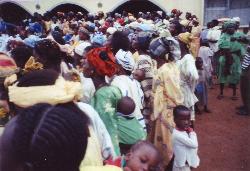
I was travelling from Akure to Ado Ekiti. Driving through Ikerre, I was lucky to to see a Yoruba theatre company getting ready to give a performance in front of the palace. It was Ogunmola's “Love of Money” I was so enchanted that I followed him on his tour and saw several more performances. When I returned through Ikerre, I walked into the palace. Looking through the open Gate, I saw a very beautiful “Brazilian” house. The Oba sent for me and took me on a conducted tour through the palace which had some Yoruba doors and carvings of great beauty. In the end he said: It is getting late. Why don't you sleep here? I was taken to a little room that was on top of the magnificent entrance gate. Just after dawn I was woken up by the Oba's flutist who recited the Ogoga's Oriki. Before I left the Oba gave me breakfast; then he said to me: The room you slept in will be yours. Whenever you pass through Ikerre, feel free to sleep there. I often made use of his hospitality.
Ulli Beier, Professor and leading scholar, African Literature and Culture, Sydney
I had a chance to take a look at your website (mypalaceinitiative.org) and I was totally blown away. I think that your Initiative is wonderful because the projects will keep alive a testimony of good times past, and give hope. Every time I visit my homecountry of Morocco, I am struck by how far our way of life has strayed from our glorious past. Keep up with the good work.
Nouredine, Oakland, Ca
What people tell us
“Your project sounds like an interesting and worthwhile one. I'm glad somebody's thinking about this, because in so much of Africa normally the only large old buildings restored have been the slave forts, and this would be a happy change from that.”
Professor Adam Hochschild, Berkeley, California
“Good for you that you are acting on preserving this important part of African society! It was so interesting to read how the palace functioned for all levels of society. What wonderful culture and traditions there are in Africa. What a completely worthwhile project and one that just must succeed. I just know people are going to want to act on this initiative.”
Alison O, Castaic, California
“This is wonderful! I am in awe of this Initiative. African palaces? I didn't even know such things existed. Your mission is definitely so worthwhile. Thank you!”
Barbara S., Berkeley, California
In the Oba's palace there is never silence
An ancient Edo saying
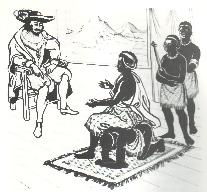
The king's palace or court is a square, and is as large as the town of Haarlem and entirely surrounded by a special wall, like that which encircles the town. It is divided into many magnificent palaces, houses, and apartments of the courtiers, and comprises beautiful and long square galleries, about as large as the Exchange at Amsterdam, but one larger than another, resting on wooden pillars, from top to bottom covered with cast copper, on which are engraved the pictures of their war exploits and battles, and are kept very clean. Most palaces and houses of the king are covered with palm leaves instead of square pieces of wood, and every roof is decorated with a small turret ending in a point, on which birds are standing, birds cast in copper with outspread wings, cleverly made after living models.
From the description of a seventeenth century Dutch engraving in Olfert Dapper's Nauwkeurige Beschrijvinge der Afrikaansche Gewesten, Amsterdam, 1668
A leader always accountable to the people
According to tradition, the palace grounds belong to the people and only they, never the King, can build on it. The King lived for the people and ruled at their pleasure.
The Oba (King) was a prisoner of his station; he had no real power. He belonged to the kingdom. Every year, the priests consulted the Ifa (oracle) to determine the king's fate. If it was decided he should die, the chiefs sent him a parrot egg...
Daniel Laine, African Kings, Berkeley: Ten Speed Press, 1991
What Daniel Laine describes above is the quintessence of democracy: the idea that a leader is always accountable to the people. As we know, traditional ways have long been ceded to colonial practices as well as the influence of contemporary society which are no respecters of Africa and her ancient traditions.
But between the restriction on the royal family and current local lethargy—lethargy stemming from the erosion of ancient value systems—the palaces have been slowly falling into disrepair for about a century. This erosion has rendered asunder the social systems that made constant maintenance and repair possible. Now, many worry that future kings, or indeed powerful individuals, may not respect the people's ownership of the palace and may rebuild or modernize it to suit their individual taste, thereby resulting in the loss of the ancient earthwork architecture forever.
Despite the worry and the disrepair, most palaces continue to function as the place of gathering for important ritual festivals and social events.

The Present, Unlike the Past...
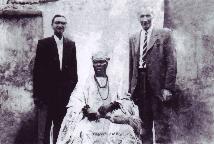
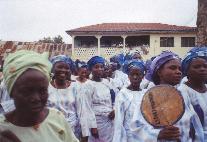
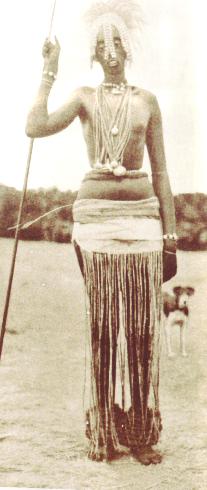
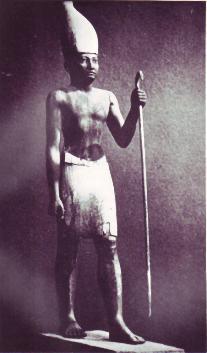
While many of the traditional functions continue at Ikere palace, disrepair threatens the palace and the values for which it stands. Indeed, many Africans have begun to look back longingly to the days when the palace was a source of pride and dignity. Also, many now believe that the demise of the ancient systems is perhaps one of the prime sources of Africa's endemic problems. For me, the collapse of the African palace system is certainly a symbol of the collapse of a rational, regional way of life.
The Benin City Walls were ravaged by the British in 1897. Since then, portions of the walls have gradually vanished in the wake of modernization--large segments cannibalized for the construction of other buildings. [Nevertheless], significant stretches of the walls remain enclosing innumerable red earth shrines and vernacular elite architecture with red-fluted walls. Though the walls and moats have been protected by national legislation since 1961, no conservation plan exists. The earthworks need to be mapped and assessed, a public awareness campaign launched, and a plan for long-term management developed.
Benin Moat: Neglected Monument In Search of a Rescuer, Hendrix Oliomogbe, Edo Nation, Va.: Herndon, 2006
Oliomogbe might well be describing thousands of Africa's ancient palaces, hence the significance of My Palace Initiative.